
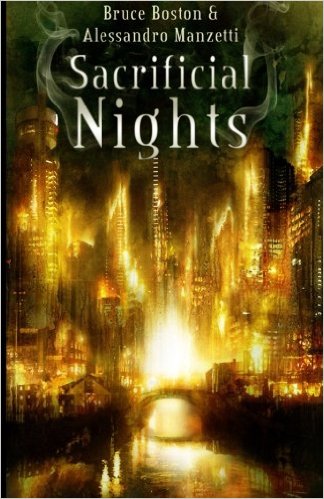
Boston, Bruce and Manzetti, Alessandro – Sacrificial Nights (Kipple Officina Libraria)
 THE GREAT UNKNOWN
i
Night, the Great Unknown,
rolled up in its own shadows,
waits with open jaws
for the night shift, the smell
of Detective Samuel Sandoval.
Night misses his old blue coat
from when he walked a beat.
It remembers the brass buttons
and the stale crumbs
of communion wafers
embedded in its threads.
Sandoval moves along
the riverside drive
followed by a skinny rat.
After an ten-hour shift,
he walks aimlessly
in the dark morning,
still high on adrenaline
and nicotine and hate.
He has to come down
before he can return
to his wife and children
and suburban refuge.
Sandoval hasn’t been
to church for years.
He no longer remembers
the face of Jesus Christ.
The last time he saw it,
it was swinging on
the silver medallion
of an ethnic gang leader,
crudely carved with
no look of suffering
anointing its features.
Rather it smiled at him.
And so did the gang leader.
A mocking sarcastic smile
that seemed to be saying,
‘Calvary, up to you now, man!’
Sandoval has been working
the night shift for five years.
He tries not to remember
the blood-scattered lines
and faults of that passage,
the lives lost along the way.
Night, the Great Unknown,
fate in bone-cold vestments,
is preparing his own demise,
dramatic and startling
or chill and indifferent
as the stone city itself.
ii
Rashida is sixteen-years-old.
Her boyfriend made her
swallow too many jelly shots.
Then he slapped her
because she would not
sleep with him,
because she wanted
to remain a virgin
until she was married.
For her, Sex is the
great dark Unknown.
She runs down the alleyway
to the riverside drive,
running away from
her boyfriend and herself,
running from a future
that is rushing too fast,
her teeth so very white
in the intermittent lights
spaced along the river.
In the long patches
of shadow in between,
Night, the Great Unknown,
claims her with its wing.
iii
Sandoval sees a flash to his right
moving fast, far too fast,
moving toward him,
a shifting flash and a shadow.
He imagines the blade of a knife
that shines in the river lights,
in the black leather of nowhere,
a blade that seeks his flesh.
“Not yet,” he thinks “Not yet,”
while Rashida runs closer,
mouth open, breathing heavily.
Sandoval hears that harsh breath.
Night, the Great Unknown
touches the back of his coat
with its unsheathed claws.
“Chills. Do you feel them, man?”
“Yeah!”
In an extended fraction
of a fractured second,
Sandoval draws his
revolver from its
shoulder strap
and shoots blindly
— once! twice! —
aiming at that sharply
shimmering light that
is nearly upon him.
The shots echo off
the condominiums
that rise along the river.
“Calvary, up to you now, man!”
“‘Who’s speaking?” Sandoval asks.
The only answer is the
rush of the river passing.
The body on the ground
has stopped moving.
iv.
Sandoval kneels beside
the body of Rashida,
curled on its side,
a silver lipstick tube
clutched in one hand.
She’s no longer masked
by the wing of night.
Her face has become
that of a girl surprised
by a sudden rainfall,
by the first and last
thunder of her life.
“Your blood…is mine…,”
Sandoval whispers
to the dead girl,
to the Great Unknown.
He has never seen the
face of an angel before.
Twin windows light up
in the building that
rises above him,
throwing his shadow
on the cracked asphalt,
then a third window,
where the Great Unknown
suddenly appears
in its shadow flesh,
dressed as a tall magician
with a top hat on his head.
A snap of the fingers
lights his long cigarette.
He inhales deeply as
he savors the scene below
as if it were a work of art.
Then he exhales and
blows a coat of fog
across the city.
Sandoval hears a siren.
Someone has called
in the disturbance.
He knows he should run,
yet he remains standing,
half bent over the body.
Though his face is
in complete darkness,
its silhouette is composed
of hard angles and lines.
He realizes that
he won’t be going
home to his family
and the suburbs tonight.
Instead he has been
crucified on the cross
of the Great Unknown.
Soon his own cohorts
will be coming with
their flashing lights
to carry him away.
“Calvary, man!”
JEAN-PAUL, THE FLYING THIEF
Summer.
The apartment is dark.
A small circle of light
runs up the ivory wallpaper,
penetrates a fissure
of the Boulle furniture,
awakens the woodworms,
asleep in their gnawed galleries.
This alien sun is the torch
of the thief Jean-Paul.
He is doing his job,
the only job he knows,
sweating and cursing,
followed by a train of moths
that appeared from nowhere,
drawn by the light.
“Damned beasts!”
Jean-Paul hears a noise.
Something is moving
in the next room.
The cocaine in his veins
melds with an adrenaline rush.
He releases the safety
on his revolver.
“Bloody hell.”
The light of the torch enters
the room and is drawn
to the ornate chandelier,
its crystals crashing into pieces
before Jean-Paul’s stoned eyes,
a thousand slanting rays.
His vision clicks
like a lantern show
of dislocated time
from one image to the next.
He sees himself climbing
the rickety fire escape,
sees himself as if
he were a being floating
in the air beyond.
Sees himself
prying the window open
and climbing awkwardly
into the room.
Sees himself as a patient
etherized upon a table,
the worn and worried eyes
of half-masked faces
looming above him.
Jean-Paul shakes his
head and looks down,
blinking from the reflections.
There is no one here:
no men, ghosts or cops.
A blue-skinned painting,
a stormy sea in the manner of Turner,
shifts inexplicably back and forth,
rubbing against one wall.
“Here’s the noise. Son of a bitch!”
There is no danger, perhaps.
The moths multiply,
continue to fly in a circle
around the head of the thief,
as if he were the only lighthouse
in thousands of miles of darkness.
Jean-Paul takes off his cap
and swipes them away.
“It’s hot in here, too damn hot!”
Yet all at once his skin feels refreshed.
The tongue of a subtle wind
is licking his cheeks and forehead,
even though the windows are shut.
The sails of the Turner ship
billow and swell to bursting,
and Jean-Paul can hear
the shouts of the sailors,
curses and cries of despair
swallowed by the storm.
He can smell the brine
of the crashing waves.
He is enveloped by a vision
of his mother and father,
his older brother,
all dead and buried,
riding the wings of that storm,
arms outstretched, legs straight,
their faces drawn back,
as if they had been
crucified upon the wind.
The thief begins
to distrust his mind,
the stuff that he bought
in the parking lot
before going to work.
That dealer, Josh,
strange guy,
looked more like an insect
than a human being,
scrawny, with those thin ears
laid back against his skull,
his arms held out
and bent at the elbows
like some praying mantis,
and dark impenetrable eyes,
just like the eyes
of those damned moths
now covering Jean-Paul
in a fluttering coat
like a second skin.
He drops the torch
and it flickers into darkness.
Like the moths, he is
now drawn to the only
visible light in the room,
the lamppost beyond the
window in the street below.
The moths begin batting
against the window
and Jean-Paul has
become one of them,
batting against the window,
trying to get to the light.
The glass shatters outward
in a starburst rush
and he is flying
like a magical being,
his features taut,
his hair blown back,
until he sees the asphalt
rushing up to greet him.
Deep in his coma,
Jean-Paul dreams he is a moth,
dreams he is a thief who can fly,
dreams of a thousand unlocked doors
and open windows.
“Bloody hell.”
LEGEND OF THE ALBINO PYTHONS
AND THE BLOODY CHILD
Slithering through the dark
bowels of the city in storm drains
where sewers often overflow,
the parthenogenic progeny
of an escaped pet python
survive on rats, unwary
city workers, and the odd
miscreant fleeing the law,
crushing the last breaths
from their trapped bodies.
Nightmares beyond reason,
they inhabit and haunt
these dank concrete
and steel corridors.
Some claim that through
generations born and surviving
in the fetid dark, they have
bred to albino pythons
capable of mesmerizing
their prey with a glance
of their lustrous purblind eyes.
Others say there will come
a day when they will emerge
from the rancid depths below,
from storm drains and manholes
and along the banks of the river.
Shunning the harsh light of day
they’ll come in dead of night,
pale specters from hellish depths
devouring sinners in their beds.
Then there are those who
tell the story of a little girl,
seen after midnight, walking
barefoot through the dark
asphalt streets of the city,
wearing torn yellow pajamas
splattered with blood and
a pale young python twined
around her neck, a living,
breathing ophidian necklace.
She is the ghost of the city’s
corruption made manifest,
a perverse little demon
with sharp young teeth.
They say it’s her, with her
flaming hair, who leaves
a phosphorescent red trail
behind her, who was the
first to be dropped into
the sewers, the first to
have seen a nest of pythons,
to heat it with her human cells.
In revenge against those who
left her to a watery grave,
she has given to the snakes
an advanced intelligence,
a key to the weaknesses
of the Lords of the Earth
who walk on two legs.
If you meet her when
you’re alone after midnight
and your own path turns
a phosphorescent red,
grasp a silver crucifix,
pray to your failed gods
for salvation, take off
your shoes and run away.
They call her Anja The Red,
this ghostly witness who
warns that in the underworld,
where your worst fears
and obsessions fester,
a reptilian dominion thrives,
waiting to embrace you
with its slick relentless coils.
THE GREAT UNKNOWN
i
Night, the Great Unknown,
rolled up in its own shadows,
waits with open jaws
for the night shift, the smell
of Detective Samuel Sandoval.
Night misses his old blue coat
from when he walked a beat.
It remembers the brass buttons
and the stale crumbs
of communion wafers
embedded in its threads.
Sandoval moves along
the riverside drive
followed by a skinny rat.
After an ten-hour shift,
he walks aimlessly
in the dark morning,
still high on adrenaline
and nicotine and hate.
He has to come down
before he can return
to his wife and children
and suburban refuge.
Sandoval hasn’t been
to church for years.
He no longer remembers
the face of Jesus Christ.
The last time he saw it,
it was swinging on
the silver medallion
of an ethnic gang leader,
crudely carved with
no look of suffering
anointing its features.
Rather it smiled at him.
And so did the gang leader.
A mocking sarcastic smile
that seemed to be saying,
‘Calvary, up to you now, man!’
Sandoval has been working
the night shift for five years.
He tries not to remember
the blood-scattered lines
and faults of that passage,
the lives lost along the way.
Night, the Great Unknown,
fate in bone-cold vestments,
is preparing his own demise,
dramatic and startling
or chill and indifferent
as the stone city itself.
ii
Rashida is sixteen-years-old.
Her boyfriend made her
swallow too many jelly shots.
Then he slapped her
because she would not
sleep with him,
because she wanted
to remain a virgin
until she was married.
For her, Sex is the
great dark Unknown.
She runs down the alleyway
to the riverside drive,
running away from
her boyfriend and herself,
running from a future
that is rushing too fast,
her teeth so very white
in the intermittent lights
spaced along the river.
In the long patches
of shadow in between,
Night, the Great Unknown,
claims her with its wing.
iii
Sandoval sees a flash to his right
moving fast, far too fast,
moving toward him,
a shifting flash and a shadow.
He imagines the blade of a knife
that shines in the river lights,
in the black leather of nowhere,
a blade that seeks his flesh.
“Not yet,” he thinks “Not yet,”
while Rashida runs closer,
mouth open, breathing heavily.
Sandoval hears that harsh breath.
Night, the Great Unknown
touches the back of his coat
with its unsheathed claws.
“Chills. Do you feel them, man?”
“Yeah!”
In an extended fraction
of a fractured second,
Sandoval draws his
revolver from its
shoulder strap
and shoots blindly
— once! twice! —
aiming at that sharply
shimmering light that
is nearly upon him.
The shots echo off
the condominiums
that rise along the river.
“Calvary, up to you now, man!”
“‘Who’s speaking?” Sandoval asks.
The only answer is the
rush of the river passing.
The body on the ground
has stopped moving.
iv.
Sandoval kneels beside
the body of Rashida,
curled on its side,
a silver lipstick tube
clutched in one hand.
She’s no longer masked
by the wing of night.
Her face has become
that of a girl surprised
by a sudden rainfall,
by the first and last
thunder of her life.
“Your blood…is mine…,”
Sandoval whispers
to the dead girl,
to the Great Unknown.
He has never seen the
face of an angel before.
Twin windows light up
in the building that
rises above him,
throwing his shadow
on the cracked asphalt,
then a third window,
where the Great Unknown
suddenly appears
in its shadow flesh,
dressed as a tall magician
with a top hat on his head.
A snap of the fingers
lights his long cigarette.
He inhales deeply as
he savors the scene below
as if it were a work of art.
Then he exhales and
blows a coat of fog
across the city.
Sandoval hears a siren.
Someone has called
in the disturbance.
He knows he should run,
yet he remains standing,
half bent over the body.
Though his face is
in complete darkness,
its silhouette is composed
of hard angles and lines.
He realizes that
he won’t be going
home to his family
and the suburbs tonight.
Instead he has been
crucified on the cross
of the Great Unknown.
Soon his own cohorts
will be coming with
their flashing lights
to carry him away.
“Calvary, man!”
JEAN-PAUL, THE FLYING THIEF
Summer.
The apartment is dark.
A small circle of light
runs up the ivory wallpaper,
penetrates a fissure
of the Boulle furniture,
awakens the woodworms,
asleep in their gnawed galleries.
This alien sun is the torch
of the thief Jean-Paul.
He is doing his job,
the only job he knows,
sweating and cursing,
followed by a train of moths
that appeared from nowhere,
drawn by the light.
“Damned beasts!”
Jean-Paul hears a noise.
Something is moving
in the next room.
The cocaine in his veins
melds with an adrenaline rush.
He releases the safety
on his revolver.
“Bloody hell.”
The light of the torch enters
the room and is drawn
to the ornate chandelier,
its crystals crashing into pieces
before Jean-Paul’s stoned eyes,
a thousand slanting rays.
His vision clicks
like a lantern show
of dislocated time
from one image to the next.
He sees himself climbing
the rickety fire escape,
sees himself as if
he were a being floating
in the air beyond.
Sees himself
prying the window open
and climbing awkwardly
into the room.
Sees himself as a patient
etherized upon a table,
the worn and worried eyes
of half-masked faces
looming above him.
Jean-Paul shakes his
head and looks down,
blinking from the reflections.
There is no one here:
no men, ghosts or cops.
A blue-skinned painting,
a stormy sea in the manner of Turner,
shifts inexplicably back and forth,
rubbing against one wall.
“Here’s the noise. Son of a bitch!”
There is no danger, perhaps.
The moths multiply,
continue to fly in a circle
around the head of the thief,
as if he were the only lighthouse
in thousands of miles of darkness.
Jean-Paul takes off his cap
and swipes them away.
“It’s hot in here, too damn hot!”
Yet all at once his skin feels refreshed.
The tongue of a subtle wind
is licking his cheeks and forehead,
even though the windows are shut.
The sails of the Turner ship
billow and swell to bursting,
and Jean-Paul can hear
the shouts of the sailors,
curses and cries of despair
swallowed by the storm.
He can smell the brine
of the crashing waves.
He is enveloped by a vision
of his mother and father,
his older brother,
all dead and buried,
riding the wings of that storm,
arms outstretched, legs straight,
their faces drawn back,
as if they had been
crucified upon the wind.
The thief begins
to distrust his mind,
the stuff that he bought
in the parking lot
before going to work.
That dealer, Josh,
strange guy,
looked more like an insect
than a human being,
scrawny, with those thin ears
laid back against his skull,
his arms held out
and bent at the elbows
like some praying mantis,
and dark impenetrable eyes,
just like the eyes
of those damned moths
now covering Jean-Paul
in a fluttering coat
like a second skin.
He drops the torch
and it flickers into darkness.
Like the moths, he is
now drawn to the only
visible light in the room,
the lamppost beyond the
window in the street below.
The moths begin batting
against the window
and Jean-Paul has
become one of them,
batting against the window,
trying to get to the light.
The glass shatters outward
in a starburst rush
and he is flying
like a magical being,
his features taut,
his hair blown back,
until he sees the asphalt
rushing up to greet him.
Deep in his coma,
Jean-Paul dreams he is a moth,
dreams he is a thief who can fly,
dreams of a thousand unlocked doors
and open windows.
“Bloody hell.”
LEGEND OF THE ALBINO PYTHONS
AND THE BLOODY CHILD
Slithering through the dark
bowels of the city in storm drains
where sewers often overflow,
the parthenogenic progeny
of an escaped pet python
survive on rats, unwary
city workers, and the odd
miscreant fleeing the law,
crushing the last breaths
from their trapped bodies.
Nightmares beyond reason,
they inhabit and haunt
these dank concrete
and steel corridors.
Some claim that through
generations born and surviving
in the fetid dark, they have
bred to albino pythons
capable of mesmerizing
their prey with a glance
of their lustrous purblind eyes.
Others say there will come
a day when they will emerge
from the rancid depths below,
from storm drains and manholes
and along the banks of the river.
Shunning the harsh light of day
they’ll come in dead of night,
pale specters from hellish depths
devouring sinners in their beds.
Then there are those who
tell the story of a little girl,
seen after midnight, walking
barefoot through the dark
asphalt streets of the city,
wearing torn yellow pajamas
splattered with blood and
a pale young python twined
around her neck, a living,
breathing ophidian necklace.
She is the ghost of the city’s
corruption made manifest,
a perverse little demon
with sharp young teeth.
They say it’s her, with her
flaming hair, who leaves
a phosphorescent red trail
behind her, who was the
first to be dropped into
the sewers, the first to
have seen a nest of pythons,
to heat it with her human cells.
In revenge against those who
left her to a watery grave,
she has given to the snakes
an advanced intelligence,
a key to the weaknesses
of the Lords of the Earth
who walk on two legs.
If you meet her when
you’re alone after midnight
and your own path turns
a phosphorescent red,
grasp a silver crucifix,
pray to your failed gods
for salvation, take off
your shoes and run away.
They call her Anja The Red,
this ghostly witness who
warns that in the underworld,
where your worst fears
and obsessions fester,
a reptilian dominion thrives,
waiting to embrace you
with its slick relentless coils.
Collings, Michael R. – Corona Obscura: Poems Dark and Elemental (self-published)
 XXII. Tombs
Where dead-man’s fingers press through damp-mold soil,
Their almost-sentient, ever-questing tendrils
Feeding on decaying flesh…the spoils
Of death…the murk and slime and stink of entrails:
Where bone-white worms consume their way through bone-
Rich earth, blindly probe vast labyrinths
Of roots until they break through ceiling-stone
And fall and crawl along forgotten plinths:
There gather ghouls in crude-rude shrouds, gaunt faces
Glistening with putrefying gore;
Grave-wax candles wane in skulls slick-smoothed,
Illuming naked souls—corruptive place,
Beyond redemption’s hope to life condemned…for
In nakedness nests biting, flyting truth.
XXVIII. Zombies
No thought, brain, mind—only black-edged face
Drained of all but need…need…need! Rage-ragged
Throat, raw from screaming horror, debases
Speech, emits primal grunts, harsh and jagged.
In rooms above, impersonal, it smolders
As it—once she—prowl-stalks its newborn child,
Each footstep nearer, each movement bolder…,
Once gravely loved, now evermore reviled.
But from our cellar-cell we hear it call,
Rough, counterfeited words to make us dream
The rash contagion over, think that all
Is as it was before…her death redeemed.
Silently, lest we should die-not-die,
we commune—my infant babe and I.
XXIX. Newborn
we commune, my infant babe and I,
in a distant place where petals peek to see,
and westwinds lift the winging butterfly,
where cloudbanks humm incessant melody
distilled as tears when earth becomes too dry
but sucks with newborn eagerness at buds.
we commune then, she, and I, with eye-
lids shuttering in well-contented floods.
I wake to touch. Her finger-lengths, half-closed
Lay broadside-cold on mine. Not now!—not yet!—
She squalls—coarse shriek! And whirlwinds expose
Fresh agonies to waiting ears and set
Sublunar notes against a rotting moon….
And then o then must she and I commune
XXII. Tombs
Where dead-man’s fingers press through damp-mold soil,
Their almost-sentient, ever-questing tendrils
Feeding on decaying flesh…the spoils
Of death…the murk and slime and stink of entrails:
Where bone-white worms consume their way through bone-
Rich earth, blindly probe vast labyrinths
Of roots until they break through ceiling-stone
And fall and crawl along forgotten plinths:
There gather ghouls in crude-rude shrouds, gaunt faces
Glistening with putrefying gore;
Grave-wax candles wane in skulls slick-smoothed,
Illuming naked souls—corruptive place,
Beyond redemption’s hope to life condemned…for
In nakedness nests biting, flyting truth.
XXVIII. Zombies
No thought, brain, mind—only black-edged face
Drained of all but need…need…need! Rage-ragged
Throat, raw from screaming horror, debases
Speech, emits primal grunts, harsh and jagged.
In rooms above, impersonal, it smolders
As it—once she—prowl-stalks its newborn child,
Each footstep nearer, each movement bolder…,
Once gravely loved, now evermore reviled.
But from our cellar-cell we hear it call,
Rough, counterfeited words to make us dream
The rash contagion over, think that all
Is as it was before…her death redeemed.
Silently, lest we should die-not-die,
we commune—my infant babe and I.
XXIX. Newborn
we commune, my infant babe and I,
in a distant place where petals peek to see,
and westwinds lift the winging butterfly,
where cloudbanks humm incessant melody
distilled as tears when earth becomes too dry
but sucks with newborn eagerness at buds.
we commune then, she, and I, with eye-
lids shuttering in well-contented floods.
I wake to touch. Her finger-lengths, half-closed
Lay broadside-cold on mine. Not now!—not yet!—
She squalls—coarse shriek! And whirlwinds expose
Fresh agonies to waiting ears and set
Sublunar notes against a rotting moon….
And then o then must she and I commune
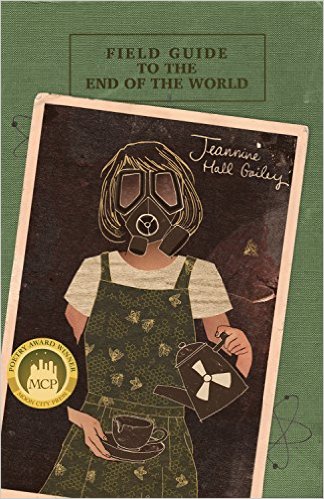
Gailey, Jeannine Hall – Field Guide to the End of the World: Poems (Moon City Press)
 But It Was an Accident
Yes, I was the one who left out the open petri dishes of polio
and plague next to the plate of pasta.
I leaked the nuclear codes, the ones on giant floppy disks from 1982.
I fell asleep at the button. I ordered tacos and turned out the lights.
How was I to know that someone was waiting for the right time?
I thought the radio was saying “Alien attack”
and headed for the fallout shelter, failing to feed the dogs.
I followed evacuation plans. I just followed orders.
I was the pilot of the bomber, I was the submarine captain,
I steered into the iceberg. I held the scalpel but I was shaking.
I was the one in charge. I was on the red phone saying “Do it” decisively.
I always imagined writing propaganda; how could I possibly see
what was coming when they dropped the fliers,
when the angry mobs began choking people in the street?
I was always good at creating a panic.
I never saw the Ferris wheel start its fatal roll.
I looked away just as the plane plummeted,
as the building burned. I shook my head at disaster, afraid to meet.
It was just an accident. It was fate. It was never my hand on the wheel.
When you point fingers, point them towards the empty sky.
But It Was an Accident
Yes, I was the one who left out the open petri dishes of polio
and plague next to the plate of pasta.
I leaked the nuclear codes, the ones on giant floppy disks from 1982.
I fell asleep at the button. I ordered tacos and turned out the lights.
How was I to know that someone was waiting for the right time?
I thought the radio was saying “Alien attack”
and headed for the fallout shelter, failing to feed the dogs.
I followed evacuation plans. I just followed orders.
I was the pilot of the bomber, I was the submarine captain,
I steered into the iceberg. I held the scalpel but I was shaking.
I was the one in charge. I was on the red phone saying “Do it” decisively.
I always imagined writing propaganda; how could I possibly see
what was coming when they dropped the fliers,
when the angry mobs began choking people in the street?
I was always good at creating a panic.
I never saw the Ferris wheel start its fatal roll.
I looked away just as the plane plummeted,
as the building burned. I shook my head at disaster, afraid to meet.
It was just an accident. It was fate. It was never my hand on the wheel.
When you point fingers, point them towards the empty sky.
Introduction to the Body in Fairy Tales
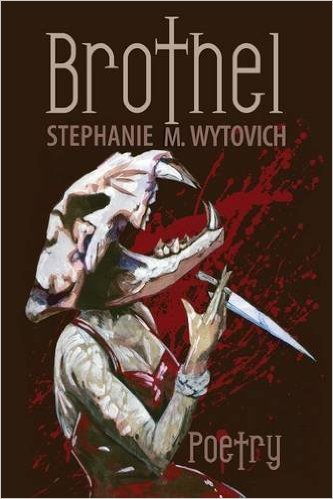
The body is a place of violence. Wolf teeth, amputated hands. Cover yourself with a cloak of leaves, a coat of a thousand furs, a paper dress. The dark forest has a code. The witch sometimes dispenses advice, sometimes eats you for dinner, sometimes turns your brother to stone. You will become a canary in a castle, but you’ll learn plenty of songs. Little girl, watch out for old women and young men. If you don’t stay in your tower you’re bound for trouble. This too is code. Your body is the tower you long to escape, and all the rotted fruit your babies. The bones in the forest your memories. The little birds bring you berries. The pebbles on the trail glow ghostly white. Post-Apocalypse Postcard from an Appalachian Chalet I’ve got my head next to a granite-strewn stream that gurgles amid sunbeams as if the whole world never went wrong. As if nothing. I’ve got at least two crates of Coca-Cola stashed inside, a pile of Little Debbie Swiss Cake Rolls, all the beef jerky I can eat. A few bears have come by, mostly uninterested, tearing through the old garbage. There are leaves and mist and no noise except the wind and once in a while, an eerie whine – foxes? ghosts? If I smell the air I can believe. This is where I came in childhood to hide. I loved the fossil rocks jutting at all angles, the tangled mountainsides full of deciduous trees. The butterflies are gone, of course, but the cicadas still hum inside their shells, oblivious. If only you were here with me. I’m far past the florescent dinosaur mini-golf and Pancake Houses, quiet now, too far from ski slopes and tourist traps to matter. Without traffic, the paved roads all seemed too lonely. If it all dies down, I thought, this is where I’d want my bones, here where the shadow of the mountains falls, in a valley of daffodils, in a chamber of forest so vast the only things to meet me will be wild things. Simon, Marge. – Small Spirits (Midnight Town Media) The Hurricane My parents left me a perfect house with many strong latched windows to keep at bay the winter winds. I filled their cases with my books, my art on walls and table tops, displayed my pagan dolls on beds, one for each passage of my life. From the coast came refugees, their faces drawn and haggard, some worried, others angry, fleeing a paradise gone wild. I saw the pick-ups pass by, station wagons with supplies, laden with what they could save. The wind stopped playing gentle games, the chimes I hung have left their hooks. I saw the trees bend down and break, heard the restive voices of the damned, the cacophony of elements, a horrendous symphony of souls, beyond the shuttered glass. I gathered up my many dolls, clutched their little bodies close while spirits screamed for hours in languages I didn’t understand, as a careless fury made its way through a house of shattered windows, they were with me through the storm. When Again I Feel My Hands My wooden hands hang idle on the strings. Master’s drunk on Holland gin & sleeps beside the wench who takes my place. Half human, half wood, in a world deprived of joy, I am the fool’s scepter, a reprieve from tedium, my simple plays enhanced by classical compositions. You cannot know how dear the price of mirth. With his dark eyes, he wooed me & with his magic, he prevailed. Father swore, mother wept as he swept me in his arms & then away to foreign lands. Soon he’ll tire of her, & cast a spell to change her form as did he mine, to suit his needs. She’ll bob & bow as I do now, and he will set me free– or so he promised, long ago. When again I feel my hands, I’ll rip away these strings & as he sleeps, I’ll pull them taut around his bearded throat, claim his magic for my own. The Anguane’s Gift She was born twisted with legs that made umber sounds with every hurtful step but her fingers were gifted with wondrous visions. Perched on a rock by the sea, she would play songs all her own on phantom strings. One bright cloudless day, an Anguane nymph rose from the water. In her arms was a golden lyre & a small doll with lidded eyes, its face a likeness of her own. “Carry these with you all your days for only you can play these strings. The doll’s eyes will open to you alone, do as it bids and be well.” Invitations to play her harp came from princesses and kings. Once, in the Orient, a thief stole her harp, but he soon realized it would not play & dulled to brass in his hands. He returned it to her, begging mercy, and this she gladly gave him. Throughout her many years, the doll’s eyes opened only to her to give unfailing direction saving her heartbreak and hardship as only magic can provide. The pain in her legs never lessened, for Anguane’s are a fickle lot, & she knew best not complain.Wytovich, Stephanie M. – Brothel (Raw Dog Screaming Press)
 Vicious Girls
Creatures,
creatures are what they are—
violent Eves, rotten apples,
victimized damsels, Salem witches;
they bit the snake that fed them
drank his poison,
pulled out his fangs
and now they bleed,
they bleed once a month for his death,
the death of the devil who cursed their wombs
for they are vicious,
they are venomous
they are women,
and they will wait,
patient and persisitent,
ever-enduring
and damned
and they will sing,
sing in covens, sing in brothels,
sing for men,
sing for whores
and their words will kill
they will damn
they will puncture
for they sing with lips,
lips not of mouth but of sex
sex that weakens, that confuses,
that traps
and once they have you
have you between their legs,
they will kill you,
they will eat you,
and they will love you
the only way
that they know how
Transaction
I
am
Nothing
but a business transaction,
something—not someone—
and you do me without feeling, without concern, for
I
am
Nothing
but a job,
something—not someone—
you use for convenience, always discreet,
fearing not to hide me
behind shadows, behind closed doors, for
I
am
Nothing,
but a window-shopped memory,
something—not someone—
that you forget the second you leave, and,
You
are
Everything
someone—not something—
to me, me who waits
in bed, at home, at work,
praying that someday, I won’t be
Nothing
to
You
Brothel
There’s a brothel in my hand
and it’s open for business, providing me with pleasure
while I pay it with my pain; I close my eyes and see,
see for the first time as immeasurable desires wake
inside me, screaming, panting: legs spread apart,
arms open wide, lips pursed, parted. The women are my
invitations, the men my RSVPs, and I’ll accept their summons
to come, to stay, to eat and drink the fruits and juices of the sweet gardens
in front of me—pulsing, dripping, rich with
honey, sweet with wine.
My mouth is open and I’m ready to inhale,
ready to swallow, and they’ve promised
they’d fill me, that they’d keep me nice and full;
I slip my fingers through the front door and
I’m met with a warm hello,
as I’m taken inside—as I’m taken—and I
think I’ll stay here for a while, locked inside
my brothel where the animals like to breed.https://staging.horror.org/wp-content/uploads/2026/09/Brothel-1.jpg|https://staging.horror.org/wp-content/uploads/2026/09/Corona-Obscura-1.jpg|https://staging.horror.org/wp-content/uploads/2026/09/Field-Guide-to-the-End-of-the-World-1.jpg|https://staging.horror.org/wp-content/uploads/2026/09/Sacrificial-Nights-1.jpg|https://horror.org/wp-content/uploads/2017/02/Small-Spirits.jpgBrothel.jpg|Corona-Obscura.jpg|Field-Guide-to-the-End-of-the-World.jpg|Sacrificial-Nights.jpg|Small-Spirits.jpg
Vicious Girls
Creatures,
creatures are what they are—
violent Eves, rotten apples,
victimized damsels, Salem witches;
they bit the snake that fed them
drank his poison,
pulled out his fangs
and now they bleed,
they bleed once a month for his death,
the death of the devil who cursed their wombs
for they are vicious,
they are venomous
they are women,
and they will wait,
patient and persisitent,
ever-enduring
and damned
and they will sing,
sing in covens, sing in brothels,
sing for men,
sing for whores
and their words will kill
they will damn
they will puncture
for they sing with lips,
lips not of mouth but of sex
sex that weakens, that confuses,
that traps
and once they have you
have you between their legs,
they will kill you,
they will eat you,
and they will love you
the only way
that they know how
Transaction
I
am
Nothing
but a business transaction,
something—not someone—
and you do me without feeling, without concern, for
I
am
Nothing
but a job,
something—not someone—
you use for convenience, always discreet,
fearing not to hide me
behind shadows, behind closed doors, for
I
am
Nothing,
but a window-shopped memory,
something—not someone—
that you forget the second you leave, and,
You
are
Everything
someone—not something—
to me, me who waits
in bed, at home, at work,
praying that someday, I won’t be
Nothing
to
You
Brothel
There’s a brothel in my hand
and it’s open for business, providing me with pleasure
while I pay it with my pain; I close my eyes and see,
see for the first time as immeasurable desires wake
inside me, screaming, panting: legs spread apart,
arms open wide, lips pursed, parted. The women are my
invitations, the men my RSVPs, and I’ll accept their summons
to come, to stay, to eat and drink the fruits and juices of the sweet gardens
in front of me—pulsing, dripping, rich with
honey, sweet with wine.
My mouth is open and I’m ready to inhale,
ready to swallow, and they’ve promised
they’d fill me, that they’d keep me nice and full;
I slip my fingers through the front door and
I’m met with a warm hello,
as I’m taken inside—as I’m taken—and I
think I’ll stay here for a while, locked inside
my brothel where the animals like to breed.https://staging.horror.org/wp-content/uploads/2026/09/Brothel-1.jpg|https://staging.horror.org/wp-content/uploads/2026/09/Corona-Obscura-1.jpg|https://staging.horror.org/wp-content/uploads/2026/09/Field-Guide-to-the-End-of-the-World-1.jpg|https://staging.horror.org/wp-content/uploads/2026/09/Sacrificial-Nights-1.jpg|https://horror.org/wp-content/uploads/2017/02/Small-Spirits.jpgBrothel.jpg|Corona-Obscura.jpg|Field-Guide-to-the-End-of-the-World.jpg|Sacrificial-Nights.jpg|Small-Spirits.jpg