
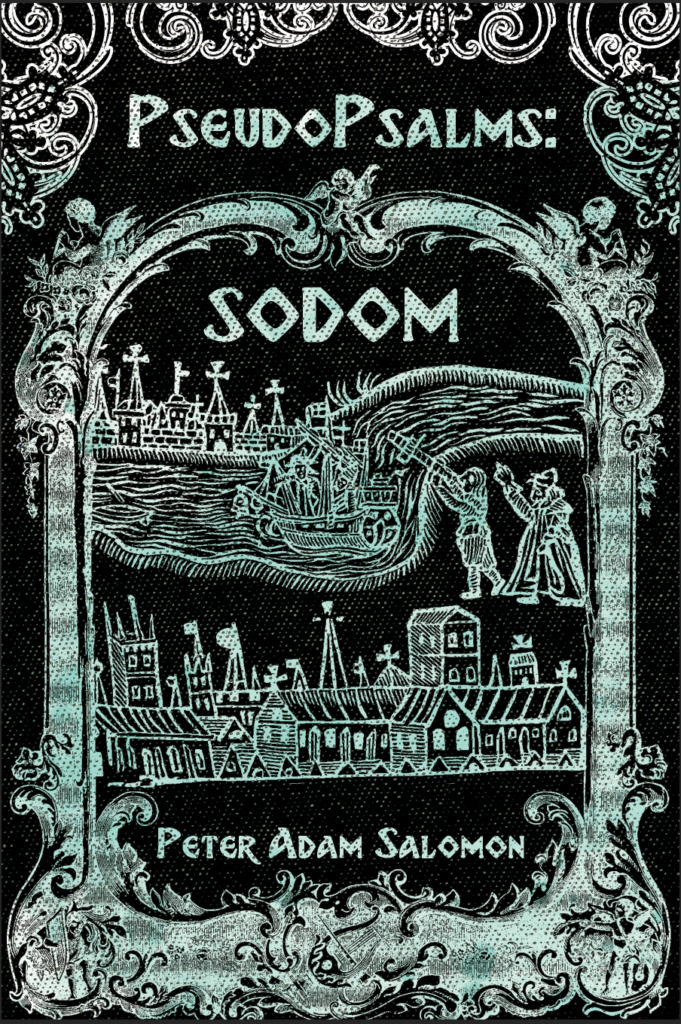
 Q: Peter, your latest two volumes of dark poetry openly start off with a religious reference –“PseudoPsalms.” Several of the poems make reference to possibly agnostic and borderline atheistic themes. Of the “taboo” dark or horror themes I’ve been told to avoid by others religion is often high on the list. For some reason it is okay to write about demons, ghosts and phantasms but, unless they have multiple cephalopod characteristics the concept of a corresponding deity is off limits. Your work seems to shrug off that aversion and take the issue of questioning belief and the existence of a “higher presence” to task. In your poem Barbed-Wire Roses (PseudoPsalms: Saints and Sinners) which focuses on the Holocaust and the Dachau concentration camp, you even ask the question I know there is a God/But I wonder where God went. In the second volume you include a poem, Teach the Agony, where the narrators states Through religion’s eyes/Where God has Failed/To protect the child within us all/ I searched for divinity/and found hypocrisy. The idea I see is someone who wants to believe but every time he or she searches they are left unsatisfied. Many of the darker elements of your other poems seem to arise from a moral emptiness that lets evil and horror breed and take their victims. Tell us about how you came to craft these volumes around these themes. And, what is the reason for the inclusion of “Pseudo” in both titles? Obviously there is a connection in the themes but is there another meaning you want to share as well?
A: First of all, what a great question! Thank you for asking.
The word ‘pseudopsalms’ is one I came up with long ago, back in high school, when I first really started questioning the entire concept of organized religion. Psalms, themselves, have such an interesting feel to them. Not quite as ‘religious’ as most of the bible, almost seeming to possess more of a ‘fiction’ feel to them, I suppose. But they’re definitely religious. I always thought of epic fantasy, Lord of the Rings, etc, to be the ‘bible’ of those realities and wanted to write a bible like that. Of course, I’m no Tolkien.
And, if the bible was simply the epic fantasy of our reality, then that led me to all sorts of interesting possibilities for writing and, especially, for poetry.
Add to that a definite affinity for the shadowy and the dark and the creepy/scary/terrifying, and in searching for my ‘voice’ as a poet, I usually found it in the questions. Questioning God, or politicians, or people, or love, or heartache, or anything. And if everything could be questioned, then everything could be touched upon in poetry.
I’m still trying to find answers, and lately my poetry has been pointedly political, rather than religious. But, still, always questioning, always demanding answers, and always disappointed at not knowing all there is to know
Q. The imagery and themes of your two volumes also bring out the idea that horror is not so much an outside invading or maliciously intervening force. Horror is the everyday that lurks within and erupts causing people to inflict pain on each other. In your poem Cubicle (PseudoPsalms: Saints and Sinners) you present what I often call the “horror of the ordinary.” This darkness that comes from the day to day destruction of what makes us human. One set of lines struck me: Even if the cubicle was a soft gray fabric hell/without a view/ there was a paycheck every other week. Later in the poem it becomes clear that the worker in the cubicle worked in the World Trade Center on September 11, 2001. So we have the horror of the everyday, the hell of the fabric cubicle and the final reward of the man speaking is to go to the window seeing another hell forming; then watching as the first person jumped. This poem mixes so many images and the tension of the horror that we know will follow. I’d like to know the creative process, if you can describe it, that went into crafting this marvelous piece of dark poetry.
A: ‘Cubicle’ was a piece I’d had in the back of my mind for a very long time, to put the reader in that particular space at that moment in time but I was never quite sure how to frame it. For a while I considered placing the reader on one of the planes, and might still do that someday. But, finally, I decided that the ordinariness of the cubicle-worker, so familiar to so many from their daily lives, spoke more to the infinite horror of that day.
And that day changed my life in so many ways just as it changed so many others.
It was a difficult poem to write, knowing where I was going with it, knowing how it was going to end. It’s a difficult poem to read, because it’s just so ordinary, as you pointed out. It’s boring. It’s real life and, early in the morning at work is boring. Maybe there are some voicemails to listen to, some emails to read, some messages to return. Co-workers to greet, coffee to make. It’s all just so plain and regular and absolutely ordinary.
Then, everything changes. In the blink of an eye. In a heartbeat. Everything changes.
And, what always strikes me as truly terrifying, is how desperately we want everything to simply be plain and regular and absolutely ordinary again.
Q: In PseudoPsalms: Sodom several times you cross into themes of child abuse. The title poem, Sodom, was very painful for me to read (Don’t look back/God will protect you/If you obey/Little girl). Again the horror is not a creature from a crypt or metaphysical accident but human crafted horror where the lack of divine intervention is as much of the injury as the physical harm. Some people I have dealt with in the writing field believe that such themes should not be dealt with, even though they represent some of the true horrors of life. What do you hope your readers take away from examining themes of this nature from your work?
A: That particular poem was another difficult one to write. But I didn’t want to shy away from what is truly horrifying in this world. Sure, an axe wielding cyborg-clown is scary or a shape-shifting alien with bloody fangs is frightening, but the rapist is real. The serial killer is real. And ‘real’ is truly terrifying. Real can hurt. Real can be evil.
I wrote a poem that was in my first collection, Pseudopsalms: Prophets, called ‘I Shut Out Your Light’ written in back-and-forth lines from the perspectives of both a rapist and his victim. I find it close to impossible even to read. And, yes, a number of poems in all three of my collections deal with child abuse. Maybe because to me that’s one of the world’s greatest evils and greatest horrors.
I recently visited the Oklahoma City Memorial and was struck by the chairs erected as monuments to those who died. Nineteen of those empty chairs are child-sized.
It was those chairs which held the most power for most everyone who visits the Memorial. And it was those chairs I wrote about in a poem to help myself process the experience.
I hope readers grasp the horrors of these situations, and understand the devastation such acts can cause, both in the moment and lingering long after the abuse ends. I look at writing dark poetry as shining a flashlight in the shadows, scattering evil by bringing light to darkness in some way.
Q: You were the first editor of the HWA’s Poetry Showcase, Volumes I and II. As I understand it you played a pivotal role in the creation of that anthology series. Tell us your role in the creation of this series.
A: Back before I was even published, in February 2014, I was talking with the brilliant poet Marge Simon about some ideas I had for the HWA poetry page that I had recently started editing. One of those ideas was a contest. Marge made some suggestions and then I emailed former HWA President Rocky Wood about an HWA sponsored poetry competition as a tie in with National Poetry Month (Marge’s idea for the tie in). Since National Poetry Month is in April, and it was already mid-February, I was thinking 2015 as a possibility. Since Rocky was on vacation, I ended up hearing from then-VP, now President, Lisa Morton the very same day with a go-ahead for April 2014. Over the next six weeks, with a great deal of support from Lisa and Rocky and Marge and other HWA people behind the scenes, we managed to put together an international poetry competition with entries from around the world, judged by Marge Simon, myself, and horror novelist Jonathan Maberry.
It was a wild ride, and I will forever be grateful to the HWA and Lisa and everyone for their support for an unknown, unpublished author’s crazy idea. And now, looking back at the past four Showcases, and its international impact on horror poetry, and looking forward as the Showcase moves on to its third Editor in the amazingly talented hands of poet Stephanie Wytovich after two years of being led by one of my own favorite poets, David E. Cowen, it is truly gratifying to see the success it’s had. All four Showcases have ended up with best-selling anthologies of some truly wonderful dark poetry and I have no doubt that streak will continue going forward.
Q: What do you think you learned in being the editor of the two Poetry Showcase volumes that helped you become a better poet?
A: Wow, I have learned SO much. I have been blessed to have been able to have in-depth amazing conversations with my fellow judges who have been best-selling novelists and award-winning poets with long, brilliant careers. I have also been blessed to read so much contemporary poetry by some amazing poets who I might never have known about if not for their entries. The Showcase has published at least one teen’s first published poem in the same volume that a world-famous best-selling poet published his very last poem. It’s published and highlighted some of the very best work by some of the very best horror poets of all time and it’s been an honor to be associated with everyone I’ve worked with on this.
Q: What’s next poetically for you Peter?
A: I am currently at work on a number of different things. My next poetry collection, Pseudopsalms: Revelation, is about half-way complete and I am working on re-issuing my first collection now that it’s gone out of print and the rights have reverted to me. After almost four years I have recently stepped down as Editor of the HWA Poetry Page and I am thrilled that it’s now in such good hands. I’m greatly looking forward to continuing to ask questions, and to hopefully maybe finding some answers along the way.
Q: Peter, your latest two volumes of dark poetry openly start off with a religious reference –“PseudoPsalms.” Several of the poems make reference to possibly agnostic and borderline atheistic themes. Of the “taboo” dark or horror themes I’ve been told to avoid by others religion is often high on the list. For some reason it is okay to write about demons, ghosts and phantasms but, unless they have multiple cephalopod characteristics the concept of a corresponding deity is off limits. Your work seems to shrug off that aversion and take the issue of questioning belief and the existence of a “higher presence” to task. In your poem Barbed-Wire Roses (PseudoPsalms: Saints and Sinners) which focuses on the Holocaust and the Dachau concentration camp, you even ask the question I know there is a God/But I wonder where God went. In the second volume you include a poem, Teach the Agony, where the narrators states Through religion’s eyes/Where God has Failed/To protect the child within us all/ I searched for divinity/and found hypocrisy. The idea I see is someone who wants to believe but every time he or she searches they are left unsatisfied. Many of the darker elements of your other poems seem to arise from a moral emptiness that lets evil and horror breed and take their victims. Tell us about how you came to craft these volumes around these themes. And, what is the reason for the inclusion of “Pseudo” in both titles? Obviously there is a connection in the themes but is there another meaning you want to share as well?
A: First of all, what a great question! Thank you for asking.
The word ‘pseudopsalms’ is one I came up with long ago, back in high school, when I first really started questioning the entire concept of organized religion. Psalms, themselves, have such an interesting feel to them. Not quite as ‘religious’ as most of the bible, almost seeming to possess more of a ‘fiction’ feel to them, I suppose. But they’re definitely religious. I always thought of epic fantasy, Lord of the Rings, etc, to be the ‘bible’ of those realities and wanted to write a bible like that. Of course, I’m no Tolkien.
And, if the bible was simply the epic fantasy of our reality, then that led me to all sorts of interesting possibilities for writing and, especially, for poetry.
Add to that a definite affinity for the shadowy and the dark and the creepy/scary/terrifying, and in searching for my ‘voice’ as a poet, I usually found it in the questions. Questioning God, or politicians, or people, or love, or heartache, or anything. And if everything could be questioned, then everything could be touched upon in poetry.
I’m still trying to find answers, and lately my poetry has been pointedly political, rather than religious. But, still, always questioning, always demanding answers, and always disappointed at not knowing all there is to know
Q. The imagery and themes of your two volumes also bring out the idea that horror is not so much an outside invading or maliciously intervening force. Horror is the everyday that lurks within and erupts causing people to inflict pain on each other. In your poem Cubicle (PseudoPsalms: Saints and Sinners) you present what I often call the “horror of the ordinary.” This darkness that comes from the day to day destruction of what makes us human. One set of lines struck me: Even if the cubicle was a soft gray fabric hell/without a view/ there was a paycheck every other week. Later in the poem it becomes clear that the worker in the cubicle worked in the World Trade Center on September 11, 2001. So we have the horror of the everyday, the hell of the fabric cubicle and the final reward of the man speaking is to go to the window seeing another hell forming; then watching as the first person jumped. This poem mixes so many images and the tension of the horror that we know will follow. I’d like to know the creative process, if you can describe it, that went into crafting this marvelous piece of dark poetry.
A: ‘Cubicle’ was a piece I’d had in the back of my mind for a very long time, to put the reader in that particular space at that moment in time but I was never quite sure how to frame it. For a while I considered placing the reader on one of the planes, and might still do that someday. But, finally, I decided that the ordinariness of the cubicle-worker, so familiar to so many from their daily lives, spoke more to the infinite horror of that day.
And that day changed my life in so many ways just as it changed so many others.
It was a difficult poem to write, knowing where I was going with it, knowing how it was going to end. It’s a difficult poem to read, because it’s just so ordinary, as you pointed out. It’s boring. It’s real life and, early in the morning at work is boring. Maybe there are some voicemails to listen to, some emails to read, some messages to return. Co-workers to greet, coffee to make. It’s all just so plain and regular and absolutely ordinary.
Then, everything changes. In the blink of an eye. In a heartbeat. Everything changes.
And, what always strikes me as truly terrifying, is how desperately we want everything to simply be plain and regular and absolutely ordinary again.
Q: In PseudoPsalms: Sodom several times you cross into themes of child abuse. The title poem, Sodom, was very painful for me to read (Don’t look back/God will protect you/If you obey/Little girl). Again the horror is not a creature from a crypt or metaphysical accident but human crafted horror where the lack of divine intervention is as much of the injury as the physical harm. Some people I have dealt with in the writing field believe that such themes should not be dealt with, even though they represent some of the true horrors of life. What do you hope your readers take away from examining themes of this nature from your work?
A: That particular poem was another difficult one to write. But I didn’t want to shy away from what is truly horrifying in this world. Sure, an axe wielding cyborg-clown is scary or a shape-shifting alien with bloody fangs is frightening, but the rapist is real. The serial killer is real. And ‘real’ is truly terrifying. Real can hurt. Real can be evil.
I wrote a poem that was in my first collection, Pseudopsalms: Prophets, called ‘I Shut Out Your Light’ written in back-and-forth lines from the perspectives of both a rapist and his victim. I find it close to impossible even to read. And, yes, a number of poems in all three of my collections deal with child abuse. Maybe because to me that’s one of the world’s greatest evils and greatest horrors.
I recently visited the Oklahoma City Memorial and was struck by the chairs erected as monuments to those who died. Nineteen of those empty chairs are child-sized.
It was those chairs which held the most power for most everyone who visits the Memorial. And it was those chairs I wrote about in a poem to help myself process the experience.
I hope readers grasp the horrors of these situations, and understand the devastation such acts can cause, both in the moment and lingering long after the abuse ends. I look at writing dark poetry as shining a flashlight in the shadows, scattering evil by bringing light to darkness in some way.
Q: You were the first editor of the HWA’s Poetry Showcase, Volumes I and II. As I understand it you played a pivotal role in the creation of that anthology series. Tell us your role in the creation of this series.
A: Back before I was even published, in February 2014, I was talking with the brilliant poet Marge Simon about some ideas I had for the HWA poetry page that I had recently started editing. One of those ideas was a contest. Marge made some suggestions and then I emailed former HWA President Rocky Wood about an HWA sponsored poetry competition as a tie in with National Poetry Month (Marge’s idea for the tie in). Since National Poetry Month is in April, and it was already mid-February, I was thinking 2015 as a possibility. Since Rocky was on vacation, I ended up hearing from then-VP, now President, Lisa Morton the very same day with a go-ahead for April 2014. Over the next six weeks, with a great deal of support from Lisa and Rocky and Marge and other HWA people behind the scenes, we managed to put together an international poetry competition with entries from around the world, judged by Marge Simon, myself, and horror novelist Jonathan Maberry.
It was a wild ride, and I will forever be grateful to the HWA and Lisa and everyone for their support for an unknown, unpublished author’s crazy idea. And now, looking back at the past four Showcases, and its international impact on horror poetry, and looking forward as the Showcase moves on to its third Editor in the amazingly talented hands of poet Stephanie Wytovich after two years of being led by one of my own favorite poets, David E. Cowen, it is truly gratifying to see the success it’s had. All four Showcases have ended up with best-selling anthologies of some truly wonderful dark poetry and I have no doubt that streak will continue going forward.
Q: What do you think you learned in being the editor of the two Poetry Showcase volumes that helped you become a better poet?
A: Wow, I have learned SO much. I have been blessed to have been able to have in-depth amazing conversations with my fellow judges who have been best-selling novelists and award-winning poets with long, brilliant careers. I have also been blessed to read so much contemporary poetry by some amazing poets who I might never have known about if not for their entries. The Showcase has published at least one teen’s first published poem in the same volume that a world-famous best-selling poet published his very last poem. It’s published and highlighted some of the very best work by some of the very best horror poets of all time and it’s been an honor to be associated with everyone I’ve worked with on this.
Q: What’s next poetically for you Peter?
A: I am currently at work on a number of different things. My next poetry collection, Pseudopsalms: Revelation, is about half-way complete and I am working on re-issuing my first collection now that it’s gone out of print and the rights have reverted to me. After almost four years I have recently stepped down as Editor of the HWA Poetry Page and I am thrilled that it’s now in such good hands. I’m greatly looking forward to continuing to ask questions, and to hopefully maybe finding some answers along the way.
Peter also shared some poems with me to include. This first one deals with the Oklahoma City bombing in 1995 and the memorial built to honor the victims. I had to visit a government office nearby a year after the bombing and cried as I walked along the chain link fence which had become a make shift memorial. The final memorial is captured brilliantly in Peter’s poem: April 19, 1995 9:03am Oklahoma City, Oklahoma There are chairs for children Across from me Too many chairs The memories a chair contains A life Lived Or one just beginning So many chairs In this hallowed stillness The sun seems out of time The birds vibrant against clouds Against blue sky Shining on chairs for children Waiting for a visit From children lost to tragedy Found in memories And memorials Names and photographs And evidence Of a crime Against humanity There are chairs for children Across from me But not lonely chairs Too many chairs for loneliness Sad though The chairs may not be lonely But they’re sad So many chairs Some smaller than others Each with a name To be remembered To be known To be visited To be remembered The memories of a child Lost A life lived Found In nineteen chairs for children Not lonely But so very sad As Peter also mentioned some of the more recent political poetry, he figured he’d include one of those too. Then... He woke up that morning Peed and brushed his teeth Shaved his face and brushed his hair Fixed his tie and buttoned his coat Kissed his wife And smiled for his kids Said hello to his neighbors On his way to work Before heading to a meeting Where he slithered into a white robe With a white hood Safety in numbers As they watched The cross burn Secure behind their masks Now… He woke up this morning Peed and brushed his teeth Trimmed his beard and brushed his hair Buttoned his shirt without a tie Ignored anyone who glanced his way While he struggled to light a tiki torch For a photo op Chanting obsolete slogans And never even bothering to hide from the cameras A mask means something I think Mask: noun ‘a covering for all or part of the face, worn as a disguise, or to amuse or terrify other people.’ Once upon a time, perhaps A mask was needed because of shame Needing anonymity to be a racist anti-Semitic prick That time, apparently Is no more No more shame The opposite of shame Those few, burning crosses behind their hoods hid from the spotlight These Hitler saluting trolls with their dollar store torches Refuse to hide behind masks Instead they take pride in their pathos Reveling in their ignorance There have always been bigots I fear there always will be Now, while we see some of their faces Far too many still hide in the shadows Taking refuge in religion and anonymity Solace in their pity Comfort in their fellow travelers Shame For shame If your god teaches you to hate That’s no god I care to know Shame For shame If your life is so small You need to blame those who are different In order to make yourself feel bigger I pity you Shame For shame If you believe You are better than me Because of the color of your skin Or the words of a sacred text Or the gender of your spouse I have news for you I’m no better than anyone Because I’m white Or straight Or Jewish Or male Or almost fifty Or worrying about cancer when I should be worrying about my kids growing up in the world you hope for But For the love of all I know You’re no better than anyone else either Put down the torches And the outdated beliefs Shame For shame Poetry won’t solve anything I fear nothing will You’ve taken off the mask Now take off the blinders Look around Listen No one is taking your rights away By having their own rights No one is taking your love away By loving who they choose No one is taking anything from you By having something for themselves No one is taking your god away By believing in a different god or none Then and now The choice is yours Everyone has their own choice To be who they want to be… …why the fuck would you choose to be a racist? Peter’s poem Cubicle from PseudoPsalms: Saints and Sinners discussed above: Cubicle The cubicle had soft gray fabric half panels Human Resources sent out various memos Of what could And couldn’t Be used on them No pushpins Or, heaven forbid, staples There was no window view I was years away from a window And probably even further from a wall Or two That could hang a photo Of the wife The kids The dog The cat I never wanted But grew to love When it decided my lap Was the best place in the world Next to sunlight Through the windows The cubicle wasn’t tall enough To block out the sound Of so many other cubicles With poorly printed photographs Scotch taped to the soft gray fabric And the constant ringing of constant phones The ‘hello/goodbye’ of all those constant calls The hum of monitors and computer fans And the occasional rattle of someone Despite the HR warnings Clipping fingernails The cubicle was loud Life was loud But life was good If life could ever be considered good There was the wife The kids The dog The cat To think of after all Even if the cubicle was a soft gray fabric hell Without a view There was a paycheck every other week Which made up for having to scotch tape A picture of the sunset To make up for the lack of a window And there were the people in accounting Who might have been friendly More than friends And never talked politics, history, or art Sticking to sports And the potential for a subway series There was no need to discuss the news We all worshiped at the same church The sermons Written in column inches In the Sunday New York Times Echoing the echo chamber With 60 Minutes and CNN Rosary and confession In a closeted world Of our own devising Where everyone agreed There was finally Peace in our time And life was If not good Close enough There was the boss stuck in logistics Because that was the only department With a spare office And he wasn’t going to live in a cubicle Like the rest of us So we didn’t see him as often as he’d like Which made the cubicle seem a little wider A little taller A little quieter Even though it wasn’t It was loud It was always loud Until it wasn’t And then was again There was no window There was the constant hum And then it stopped Not all at once Like we’d lost power That’d happened a few years before And we’d gone on As though nothing had happened Because it was the end of history And nothing ever happened Or at least That’s what we were told And we listened Because we were told to listen To what we were told And so we listened And pretended nothing happened Even though Looking back Something happened Something bad But we’d lost power Then we got power back And life went on As though nothing happened But today was another day And nothing happened Because we listened when they told us Nothing happened And it wasn’t quiet all at once Like we’d lost power Again No This was different This was a subtle Gentle Quiet It started near the windows Something about a fire But no two people knew the same thing And since nothing ever happened And we still had power And the fabric half-walls of my cubicle Still surrounded me in their soft gray embrace I kept working The phones rang The ‘hello/goodbye’s’ continued Every phone at once It seemed Like gravity People gravitated to the windows All the way on the other side of the office To stare at the smoke And the fire And then To stare As rumors spread And the silence spread And the fire spread And the first person jumped We watched Unaware That on the other side of the office At the other windows People gravitated To stare at the blue sky Which should have been empty But wasn’t Because nothing ever happened Until something did Poems from PseudoPsalms: Sodom Ravings of a False Prophet Search inside Within the hidden depths of soul Find eternal emptiness Then find the key Escape the prison Which masks the fear Question what you see Deity, wholesome, wicked Power, life, and death Ritualistic riddles hide the secrets of eternity Behind aggressive animosity Simply to touch forbidden answers Question if you will Choose to open rusty chambers Or will you choose sacrilege and sacrifice To know the truth they kept from us Question if you can That what is known is known is known Rapture, revelation, revenge, and retribution Study prohibited knowledge and whisper it to me Wish to be a God Science cannot save you Only makes the ovens more efficient Religion fails over and over and over again To the point that anti-religion Becomes a religion all its own Philosophy lies in truth Good and evil gave birth to sophistry There are no answers to be found If you study only what they allow How much will you never learn? Sodom Don’t look Little girl Don’t turn around Nothing to see Little girl Keep your eyes closed Your head down And run Little girl Don’t look back God will protect you If you obey Little girl There’s nothing to see Just run Don’t open your eyes You don’t want to know Little girl How the guilty suffer Little girl The sinners Burning The evil Punished for their crimes Little girl Damned to hell Where angels fear to tread Don’t turn around Little girl Run Little girl Eyes closed Head down And run Don’t look back Little girl Don’t ever look back There’s nothing to see In the shadows behind you Just keep your eyes closed Little girl I’ll let you go I promise Little girl You have my word Just don’t turn around Little girl Keep your eyes closed It’s almost over Little girl Almost There Little girl Such pretty eyes Little girl I told you not to look Ordered you not to turn around But you had to be defiant Had to look To see Little girl You just had to know What I looked like And now you’re not only a victim You’ve become a witness Little girl Can’t have that Little girl You shouldn’t have looked Little girl Should have kept your eyes closed And God would have protected you I would have let you go Rather than turn you Into nothing But the dried paths Of salty tears Down the cheeks Of those who buried you Little girl Teach the Agony The fist tightens upon the world Landing within the factories Where children work to death To make toys for children They’ll never be able to afford to play with One more agony defined Lost amidst the multiplicity of agonies Child soldiers Child brides Child slaves And child laborers There’s a pattern If you look Are you looking? Do you see? Or do you turn aside To focus on petty microagressions Because a pronoun is a pronoun is a pronoun Is vital and important and worthy of your protest But a seven-year-old girl Stoned to death On the other side of the world For the crime of being raped You can ignore From the safety of your ivory tower Searching to try Trying to understand Through religion’s eyes Where God has failed To protect the child within us all I searched for divinity And found hypocrisy As you ranted and raged The insignificance of your elitist battle cry Should shame you When so many need your help And you refuse to see In closing to my questions Peter wrote: I figured I’d close . . . with a short poem, that finishes up the odd second part of PseudoPsalms: Sodom. Song of Salomon is something I’ve long thought about, the ‘what happened next’ aspect of the far more famous Song of Solomon from the bible. One of the most well-known collections of ‘love’ poetry, immortalized in the best-selling book of all time, the Song of Solomon is iconic and eternal. I, of course, had to ask: ‘what happened when they broke up?’ Ends And alone, it ends Suddenly The way the storm breaks Leaving poetry Nothing but broken words Letters scattered across the paper Without meaning Or purpose Alone Even poetry Ends Peter’s Bio: Peter Adam Salomon is a member of the Society of Children’s Book Writers and Illustrators, the Horror Writers Association, the Science Fiction & Fantasy Writers of America, the Science Fiction Poetry Association, the International Thriller Writers, and The Authors Guild and is represented by the Erin Murphy Literary Agency. His debut novel, HENRY FRANKS, was published by Flux in 2012. His second novel, ALL THOSE BROKEN ANGELS, published by Flux in 2014, was nominated for the Bram Stoker Award for Superior Achievement in Young Adult fiction. Both novels have been named a ‘Book All Young Georgians Should Read’ by The Georgia Center For The Book. His short fiction has appeared in the Demonic Visions series among other anthologies, and he was the featured author for Gothic Blue Book III: The Graveyard Edition. He was also selected as one of the Gentlemen of Horror for 2014. His poem ‘Electricity and Language and Me’ appeared on BBC Radio 6 performed by The Radiophonic Workshop in December 2013. Eldritch Press published his first collection of poetry, Prophets, in 2014, and his second poetry collection, PseudoPsalms: Saints v. Sinners, was published in 2016 by Bizarro Pulp Press. In addition, he was the Editor for the first books of poetry released by the Horror Writers Association: Horror Poetry Showcase Volumes I and II. He served as a Judge for the 2006 Savannah Children’s Book Festival Young Writer’s Contest and for the Royal Palm Literary Awards of the Florida Writers Association. He was also a Judge for the first two Horror Poetry Showcases of the Horror Writers Association and has served as Chair on multiple Juries for the Bram Stoker Awards.https://staging.horror.org/wp-content/uploads/2026/09/Sodom20Cover.pngSodom20Cover.png